Posted on the 29th of January 2026
European Rabbit
Scientific Name: Oryctolagus cuniculus

A rabbit I found
Morphology and Range

A rabbit foraging at night
The European Rabbit is a small terrestrial mammal that weighs around 1.2-2Kg and has a length around 40cm. While rabbits as a whole can come in a wide variety of colours, the European rabbit is always a mix of different shades of brown. This makes it very easy for them to blend in on bare ground, detritus and under bushes.
Despite being called the European rabbit, this species is only native to one small part of the continent, the Iberian peninsula. They can be found outside of the peninsula as populations have been introduced around the continent and have since become naturalised. That’s how we have these rabbits all over the UK.
The European rabbit hasn’t just been introduced to Europe, they’ve also been introduced to Australia. Rabbits have become very successful in Australia. However maybe too successful as they’ve caused great damage to crop fields and increase their population all year as Australian winters are warm enough for the rabbits to continue to breed through the season. These issues and several other have lead to the European rabbit being considered invasive in Australia.

A rabbit I found hiding under a bush
A rabbit I found running around at night
Rabbit Diet and Breeding
Rabbits are herbivorous, primarily feeding on young leaves and shoots as well as various grasses. As this plant material is full of cellulose it is very hard to break down. To overcome this rabbits have become coprophages, this is where a species eats its own excrement to digest any nutritious material that didn’t fully break down and get absorbed the first or second time around.
Rabbits breeding season is around January-August, where a dominant male (buck) mates with multiple females (does) within their warren. A warren being a system of burrows that a group of rabbits live within. Lower ranking bucks within the warren tend to form monogamous pairs with a single doe. Does build smaller burrows away from the main warren, which they use while raising their offspring. The European rabbit’s pregnancy takes about a month where the doe then gives birth to on average 3-7 kits that become independent after about four weeks. Bucks then reach sexual maturity after four months but does can be anywhere between five to three months.
Some rabbits I found running around

Rabbits and Hares
A running European rabbit I found
It’s not uncommon for someone to mistake a hare for a rabbit and vice versa. Which is quite understandable, they are both members of the family Leporidae and thus quite closely related species. Hares are larger than rabbits, they also have longer bodies and ears. While rabbits tend to live in groups, hares are much less social and tend to be solitary.
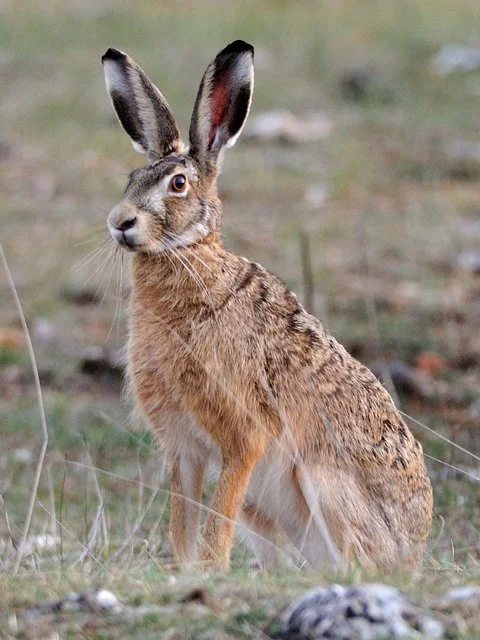
A European hare
Credit: Jean-Jacques Boujot